
Image courtesy of Social Security Administration
United States (U.S.) federal tax credits, through the Congressional Bipartisan Infrastructure Law, commonly referred to as the Inflation Reduction Act (IRA) was signed in to law on August 16, 2022, by former President Joseph R. Biden; inaddition to States and local power utilities rebates, it provided Americans and domestic manufacturers incentives to make investments in renewable energy generation and storage.
In July of 2025 the Republican led majority U.S. House & Senate eviscerated the IRA with their passing of the Budget Reconciliation Bill; colloquially known as the “One Big Beautiful Bill.” The Congressional tax bill eliminated the 30% federal credit for residential solar and wind energy by the end of 2027, including electric vehicles (EV) incentives; while bolstering the coal, oil & natural gas (NG) industries. On top of long standing legacy federal subsidies, the fossil fuel industry have now been given unfettered access to oil and natural gas drilling on federal lands and waters. Ironically, the royalties the fossil fuel industry has to pay the U.S. government for access to federal properties have been reduced.
Inaddition to the demise of the IRA, there are further attempts by the current U.S. administration to cripple renewable energy production in America. On June 12, 2025 the Executive branch of the U.S. government blocked the state of California legislation (2022 California Advanced Clean Cars II). The ACC2 is a California state law to phase-out the sale of new combustion engine vehicles by 2035 and promote clean-air policies.
On August 19, 2025 the U.S. Department of Agriculture (USDA) paused a grant program that provides grants and loans to Farmers whom desire to use renewable forms of energy production like solar panels or wind turbines. U.S.D.A. Secretary Brooke Rollins said “It has been disheartening to see our beautiful farmland displaced by solar projects.”
Ground mounted solar PhotoVoltaics (PV) arrays have been criticized for clearing and stealing arable land that could be used for agriculture. This criticism is astounding considering that forest are mainly burned and cleared for cattle ranching—which is the leading cause of deforestation. However, ground mounted solar PV arrays can coexist along with livestock. Livestock can graze on pasture growing under elevated ground mounted solar arrays. This dual purpose use of the land provides a symbiotic relationship for both energy production and agriculture; giving family owned and cooperative farmers another sustainable revenue stream. Through transpiration, the plants below keep the solar array cool boosting power production. Plants benefit from the shade of the array and are shielded from heavy rains, hail and sun stress. Plants do have a limit on the amount of sunshine they can metabolize known as light saturation point. Once a plant reaches this maximum rate of photosynthesis the plant starts evaporating water to cool itself. Agrivoltaics reduce the amount of water evaporation from plants reducing water loss and agricultural water usage.
On August 29, 2025 the U.S. Department of Transportation suspended $679 million in federal funding for projects that supports 12 offshore wind turbine projects across 9 U.S. states. The off-shore wind turbine projects were fully permitted and most are more than 80% complete; putting hundreds of thousands of direct & indirect green construction jobs at risk nationally. Revolution Wind is a 704 MW capacity offshore wind farm, located on the Outer Continental Shelf in a federally managed leased area off the coast of Rhode Island that was issued a stop-work-order despite 45 of its’ scheduled 65 Siemens Gamesa wind turbines having already been installed and operational. The Revolution Wind farm was expected to provide the states of Rhode Island and Connecticut with 400 MW & 304 MW, respectively, of clean generated electricity; and provide electricity for 350,000+ homes. Now, 1,200+ green energy Union jobs are at risk along with thousands more direct / indirect jobs through investments in the local economy.
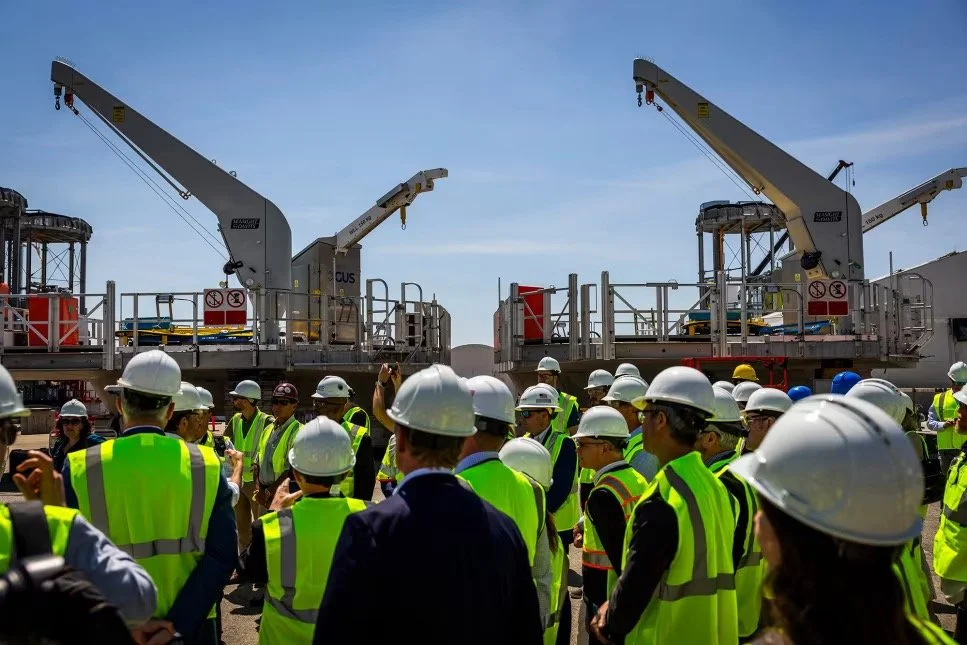
Image of green energy workers at the Providence, Rhode Island Revolution Offshore Wind construction hub 6/13/24 courtesy of CNN
The energy demands of A.I. data centers, crypto currency mining and online shipping mega-hubs like Amazon Fulfillment Centers, have increased and strained existing demands for electricity. The utility energy providers, like PJM, have made deals that mainly benefit A.I. data centers while passing on the burden of new infrastructure cost to residential customers.
The U.S. largest energy grid, PJM, which covers 13 states in the midatlantic, midwest and south, has raised electricity prices as much as 22% compared to last year in a capacity auction held in July of 2025.
With already rising utility gas and electric prices, the loss of the IRA federal tax incentives will not deter savvy U.S. consumers from adopting decentralized cheap renewable energy like rooftop solar with battery storage as a viable economic response to increasing U.S. utility energy prices.
The U.S. government divorce from renewable energy investment may prove to be detrimental economically, technically & a security setback as the rest of the world embraces renewable energies and continues to achieve advances in renewable energy technology and battery storage; along with EV manufacturing. According to the U.S. Energy Information Administration (EIA), 81% of all new electric-generating capacity to the U.S. electrical grid in 2024 came from renewable energy sources.
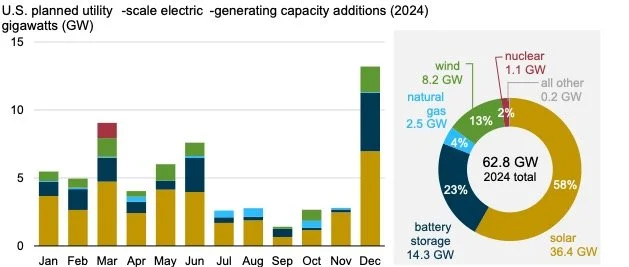
Image courtesy of U.S. Energy Information Administration
As climate change related extreme weather events increase, consumers are inevitably realizing renewable energy with battery storage democratizes energy production in the hands of consumers and are readily accessible clean / economical forms of energy compared to coal, natural gas and even nuclear energy.
At the time of this writing, electrical energy generated by unsubsidized renewable energy, in the forms of solar, wind, hydro, and geothermal supplemented with battery storage, are the “lowest cost” forms of energy generation compared to the exploration, extraction, processing & transport of the incumbent carbon based fossil fuels (oil, coal and gas); including nuclear energy.
The economic inviability of oil & natural gas are due to how incredibly expensive exploration, extraction, processing & transportation of the commodity is and if it were not for U.S. government intervention in the forms of tax breaks and subsidies for oil producing corporations fossil fuel prices would be astronomically higher for American consumers.
* The information provided does not constitute professional tax advice or professional financial guidance. Please consult a tax professional.
Please share your thoughts or experiences in the Comments section below.