THE ECONOMICS OF RENEWABLE ENERGY

Photo courtesy of Shutterstock
Renewable energy like solar and wind are inherently free fuels, making their lifetime operational cost lower than fossil fuel burning power plants. Solar and off-shore wind energy generation are now respectively 41% and 53% cheaper than fossil fuels energy generation. The renewable energy industry creates more jobs per unit of energy and per dollar invested than in traditional fossil fuels industry. Globally, the renewable energy industry have added nearly 2.5 million renewable energy jobs in 2023, bringing total employment in the industry up to 67 million globally in areas including, but not limited to manufacturing and infrastructure development. In 2023 alone, the renewable energy sector drove 10% of global GDP growth. It is reasonable to believe that the business community interest in renewable energy may rely less on its environmental merits and more on its economic advantages.
The combustion of fossil fuels in the forms of: oil, gas and coal convert a higher percentage of their imbedded carbon energy in to power at 25% - 50% efficiency. Coal plants operate at 28% - 35% efficiency, while natural gas combined cycle plants operate at up to 50% efficiency; however, all losing the remainder of their energy generation as waste heat. Most residential solar panels convert 22% - 24% of sunlight in to electricity—in the form of direct current (DC). Photons from sunlight strike solar PV cells where they excite electrons producing electricity. To put things in perspective, natural plants have a net leaf efficiency of 5.4% photosynthesis to covert 1% - 6% of visible sunlight (400 - 700 nanometers wavelength) in to biomass stored chemical energy in the form of glucose—using carbon dioxide and water while releasing oxygen as a byproduct. Chlorophyll in plants is only capable of using visible—red & blue—lights which makes up 45% of total sunlight while infrared and ultraviolet light either pass through the leaves or the leaves reflect green light—which is why leaves look green to Human eyes. Renewable energy does not compete with fossil fuels on energy density but by using fuel sources that are free and easily accessible to everyone.
Despite the higher energy density of fossil fuels the economic and environmental advantages of renewable energy generation outweighs any energy density benefit fossil fuels may have because renewable energy does not come with the various burdens associated with fossil fuels. Similarly, nuclear fission, not to be confused with fusion, energy is not considered a sustainable and financially viable clean energy option. Most U.S. nuclear power plant projects exceeded their planned construction budget ($10 billion to $35+ billion (USD) per multi-reactor power plant) & scheduled completion date; taking up to 20 years from design to operation. The average U.S. nuclear power plant is designed and licensed to operate for up to 40 years or more. However, their spent high-level radioactive fuel waste remains hazardous for 10,000 to 300,000 years requiring long-term deep geological disposal in secured locations. Any financial gains generated from nuclear energy are lost in their lifespan operational / maintenance cost, debt, decommissioning and spent fuel waste disposal.
The fuel cost of electrical generation from nuclear power excluding equipment & maintenance cost is $6 to $10 (USD) / MWh, while natural gas (Combined cycle) is $20 to $30 (USD) / MWh and coal power $17 to $25 (USD) / MWh; while solar and wind power are $0 (USD) / MWh because sunlight and wind are free.
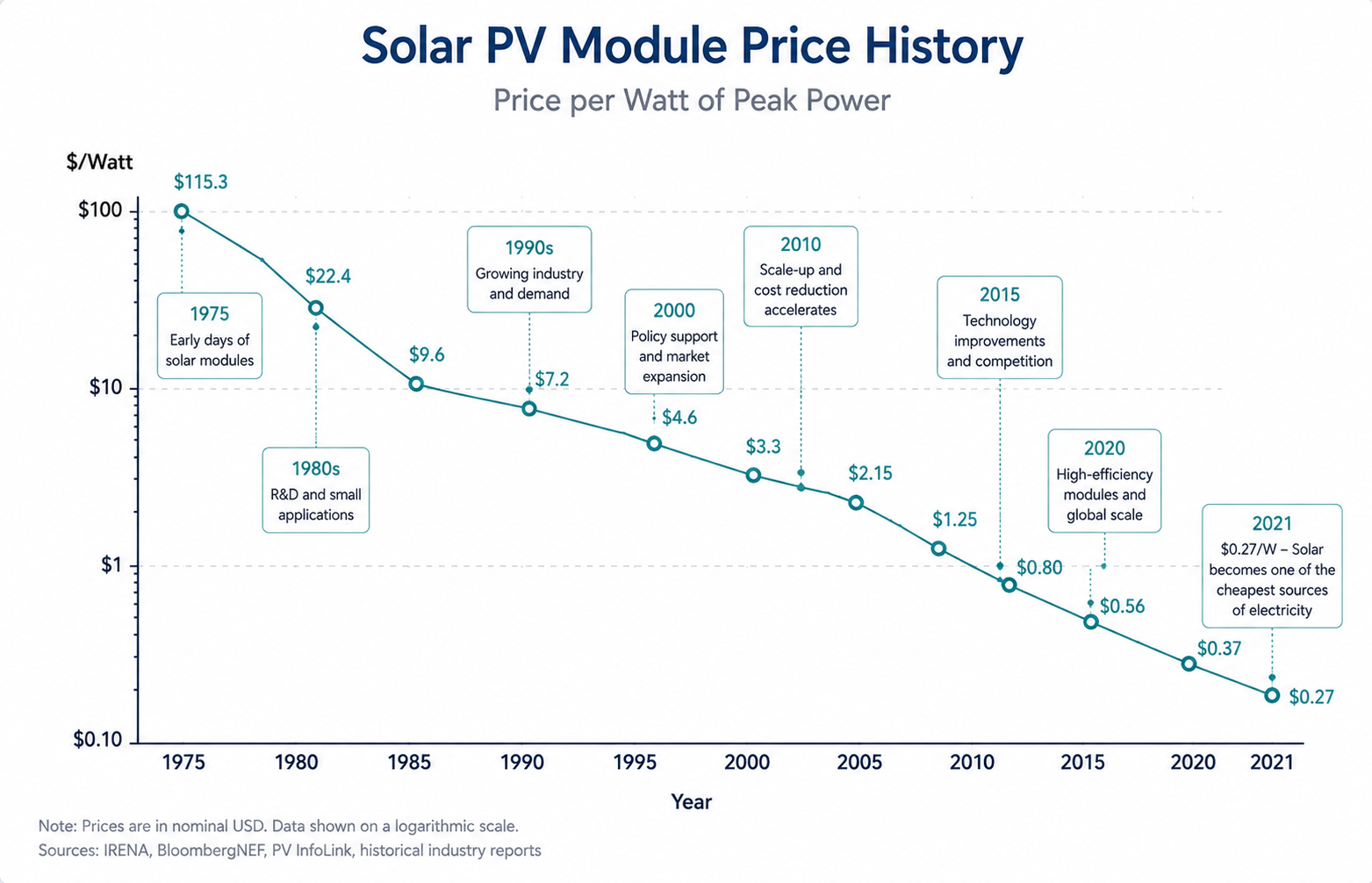
Photo courtesy of Our World in Data
Fossil fuels are single-use only energy resources that require continuous expenditures in exploration, extraction, processing, refining, transportation and storage; along with vulnerabilities to geopolitical conflicts, trade tariffs and material supply chain disruptions; all while generating environmental pollution—creating global health risks. Renewable energy replenishes itself daily from nature; without expenditures and manual labor—No one owns the sun ! No one owns the wind ! Solar photovoltaic (PV) has near-zero fuel waste, no thermal combustion, no friction, no geological extraction, no energy generation pollution, no CO₂ emissions, no fluid effluent, no gears, no moving parts and no noise. Natural gas and crude oil are not infinite natural resources, their ancient development was dependent on a geologic time clock with a timeline that spaned over millions of years.
Renewable energy coupled with battery storage are the most economical & sustainable forms of energy generation compared to fossil fuels energy. The trajectory of advances in solar photovoltaic (PV) technology is increasing exponentially the efficiency & scale of renewable energy generation along with the energy density of lithium battery storage lowering the cost of renewables. Most work horse Lithium Iron Phosphate (LiFePO4) batteries are capable of 2,000 to 6,000+ charge cycles before their capacity starts to drop to about 80%. Sodium battery storage technology is soon poised to supplant lithium batteries in cost per watt and efficiency. Sodium (Na) is the most common alkali metal and the 6th most abundant element on Earth (0.18% by mass). Unlike lithium that is largely concentrated in specific geographic regions, sodium is found in large quantities globally in rock deposits and dissolved in oceans & salt lakes. Sodium falls just below lithium in energy density; but sodium is not intended to initially compete with lithium this way, but in abundance and superior cold weather endurance.
The cost of battery energy storage has declined by 93% since 2010; while simultaneously, the wattage capacity of solar PV panels have increased as their cost per watt have fallen by 99.6% since 1976; from over $75.00 (USD) per watt in the late 1970’s down to roughly $0.18 - $0.25 (USD) per watt today—a decrease of 400x’s. Domestic renewable energy generation provides price stability & predictability by severing reliance on imported hydrocarbons and avoiding volatile price instability caused by global energy market disruptions.
The fossil fuel industry (oil, gas and coal) is gifted between $10 billion to $52 billion (USD) annually in “direct” federal subsidies by the U.S. government. Another $649 billion to $700 billion (USD) annually in “indirect” subsidies are gifted to the fossil fuel industry in the forms of immediate deduction of cost associated with drilling new wells, very low leasing rates (at below market value royalty rates) to access federal lands & waters for fossil fuel extraction, percentage depletion tax deduction; along with the financial burdens shifted to U.S. taxpayers to pay for the public health impacts, global military defense of international shipping oil routes. Environmental pollution cleanup and human caused extreme weather events (heat waves, intense storms, droughts heavy floods & seismic activities) are not priced in to the true cost of fossil fuels. According to the International Monetary Fund (IMF) the total cost of federal subsidies gifted to the fossil fuel industry is roughly $760 billion (USD) annually.
The utility companies business model, with the blessing of regulatory energy commissions, allows them to earn a 10% profit on their assets from construction: power plants, transmission lines, sub stations, new infrastructure construction—they are incentivized to maintain expansion. The utilities lose money when consumers use their own money to purchase & install on/off-grid rooftop or ground mounted solar PVs, especially if the system has battery storage, which the utilities does not own or control. This explains some utilities reluctance to pay residential consumers through Net Metering (credits) or Net Billing for the electricity they back-feed in to the utility grid. Some owners of rooftop or ground mounted solar PV find it more economical and self reliant to store excess electricity generation during the day in an off-grid battery bank which is then used at night to provide household energy.
Some rural communities and developing nations may not have the convenience of connections to the energy grid. With the latter, it can be a vestige of colonial economic and environmental exploitation which also denied investments in energy infrastructure that did not financially benefit imperialist extraction of resources. The renewable energy transition is the catalyst for the democratization of energy generation independence from legacy fossil fuel corporations. Similar to how the mobile communications transition in rural communities and the global south skipped a need to connect to the conventional telephone land lines and instead leap frog to wireless communications using mobile cellphones and tablets. Oil and natural gas are traded globally using the Dollar—the worlds’ reserve currency. Independence from volatile imported fossil fuels prices generates more money and savings in developing economies increasing their Gross Domestic Product (GDP).
The value of global south exports are devalued in order to obtain Dollars. Subsequently, the transition to domestic renewable energy production has the potential to wein the global south from the Dollar. The implementation of renewable energy has created new job opportunities for the global south.
SOCIAL COST OF FOSSIL FUELS COMBUSTION:
The burning of fossil fuels coupled with deforestation, consumerism and certain industrial manufacturing release carbon dioxide and methane which trap atmospheric heat subsequently altering global weather patterns exasperating natural weather disasters in strength, duration and frequency. These human influenced climate changes results in extreme weather events which negatively impacts health.
The burning of fossil fuels are associated with over 7 million premature deaths annually from particulate matter and nitrogen dioxide pollution. The economic health damages of air pollution secondary to the combustion of fossil fuels amounts to $8.1 trillion (USD) each year; equivalent to 6.1 % of global GDP.
According to a 2021 paper published in “Nature Climate Change” over 1/3 of all heat related deaths can be attributed to climate change influenced extreme weather events. Although cold weather deaths outnumber those caused by extreme heat, at a global rate of 9 to 1, deaths caused by climate change related extreme heat events are increasing as populations not used to dealing with this increasing threat are caught unprepared.
We would be remiss if the economics of electric vehicles (EV’s) were not discussed. Although the sticker price of EV’s may still be on par or in some cases even more than internal combustion engine (ICE) vehicles the consolation is EV’s are more efficient, cheaper to run and maintain over their lifetime than ICE vehicles. EV’s have fewer moving parts than ICE vehicles, no oil changes, no spark plugs, no timing belts and no exhaust system repairs; even the regenerative braking reduces wear-and-tear on the brake pads. EV’s can be even more cheaper to operate if powered by home EV charging; especially, if the electrical source is from residential solar PV or wind. EV’s use far less energy per mile than ICE vehicles. Since the invention of the first Model T combustion engine a 100 years ago little technological progress has been made with internal combustion engines miles per gallon (MPG) efficiency, which remains at a dismal 30% of efficiency. In contrast, electric motors convert more than 77% of electrical energy in to kinetic energy compared to gas engines which waste most of their fuel energy as heat. According to the U.S. Department of Energy “today’s light-duty all-electric vehicles or PHEV’s in electric mode can exceed 130 MPGe and can drive 100 miles consuming only 25 - 40 kWh.”
On August 29, 2025 the U.S. Department of Transportation suspended $679 million in federal funding for projects that supports 12 offshore wind turbine projects across 9 U.S. states. June - August of 2026, the U.S. government spent nearly $4 billion to buy back about a dozen off-shore wind turbine leases from companies like TotalEnergies Deal, Invenergy and the German firm RWE, under the condition that these firms reinvest those funds in to US domestic fossil fuels projects like natural gas-fired power plants and shale gas production. The off-shore wind turbine projects were fully permitted and most are more than 80% complete; putting hundreds of thousands of direct & indirect green construction jobs at risk nationally. The relinquished lease areas in the Gulf of Maine and Morro Bay had a generating potential of 4.8 gigawatts (GWs) in wind power capacity enough to electrify more than 3.5 million homes. Revolution Wind is a 704 MW capacity offshore wind farm, located on the Outer Continental Shelf in a federally managed leased area off the coast of Rhode Island that was issued a stop-work-order despite 45 of its’ scheduled 65 Siemens Gamesa wind turbines having already been installed and operational. The Revolution Wind farm was expected to provide the states of Rhode Island and Connecticut with 400 MW & 304 MW, respectively, of clean generated electricity; and provide electricity for 350,000+ homes.
The economic benefits & innovations of renewable energy is inconsequential to energy corporations and the utilities because they cannot make overwhelming profits from renewable fuel sources that they cannot commoditize or dominate. Energy corporations have no incentive to provide Humanity with abundant clean energy and reduce, if not, eliminate green house gas emissions; because any altruistic green business strategy is antithetical to their ability to make continual growth and profits. The Tiny Off-Grid House exemplifies true energy independence and sustainability through the exclusive use of abundant carbon-free renewable energy which does not endanger our health and our stewardship of the Earth; it is possible, it can be done.
Please share your viewpoints or experiences in the Comments section below.