SMOKE / CARBON MONOXIDE ALARM & FIRE EXTINGUISHER
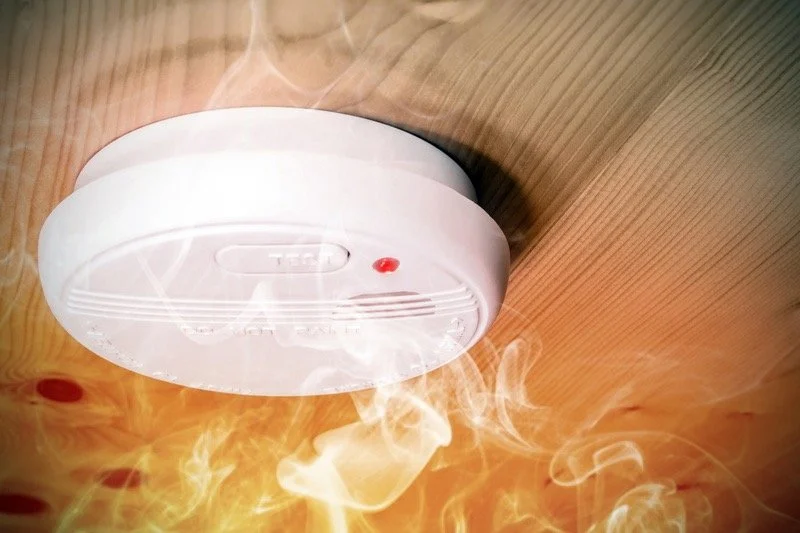
Photo courtesy of Service Fire Equipment
Carbon monoxide (CO) is often called the invisible killer. CO is an odorless, colorless gas created when carbon based fuels, in no order of importance: wood, coal natural gas, propane, methane & oil experience incomplete combustion. Most scenarios of CO emissions may involve heating and cooking, including grilling equipment; combustion engine vehicles or gas generators running in an attached garage or small enclosure.
When CO gas enters the lungs the normal fusion between red blood cells and fresh oxygen is interrupted. Ironically, red blood cells have a greater affinity for CO gas than to oxygen; binding the two together depriving the organs of much needed oxygen. Signs and symptoms of CO poisoning mimic flu symptoms of headaches, dizziness, nausea and light headedness . . .
Although the solar / wind powered Tiny Off-Grid House is not intended to utilize equipment powered by carbon based fuels, out of an abundance of caution and for purposes of research “combination” smoke and CO Smart alarms will be installed in a central location outside each sleeping loft and the Engineering Department. It is possible one or more smoke / CO alarms may serve more than one area due to their proximity to each other. The Smart feature uses WiFi to enable remote monitoring and notifications to mobile devices.
The smoke / CO alarms installed will comply with Underwriters laboratories (UL) 217 and UL 2075 and meet the sensitivity testing and alarm thresholds of UL 2034 or CSA 6.19
According to a National Fire Protection Agency (NFPA) research article by Tucker McGee, 6/1/2024, three out of every five home fire fatalities occurred due to either no smoke alarms or no working smoke alarms.
NOTE:
A smoke / CO “detector” monitors for the presence of smoke & CO and is connected to a fire alarm system. While a smoke / CO “alarm” has a sensor and makes audible alerts of the presence of smoke, CO and heat. A “Smart alarm” extends the operational capabilities of a smoke / CO alarm with remote monitoring and notifications to mobile devices.
There are smoke / CO alarms with alert devices for those whom are hearing impaired / hard of hearing that emit flashing strobe lights or vibration alerts when an alarm is activated.
SMOKE / CO ALARM MAINTENANCE
It is recommend to test smoke / CO alarms once every month. Most models have a test button. Follow the manufacturer’s instructions for cleaning the surface of debris that may clog the sensor vents. If the smoke / CO alarm is over 7 to 10 years old it has to be discarded and replaced with a new device—since the internal radioactive material used in the sensor only has an effective life expectancy of 7 to 10 years from date of manufacture; not date of purchase.
A tiny amount of radioactive material powers either an “ionization sensor” that ionizes air molecules in to positively and negatively charged molecules that create an electric current or a “photoelectric sensor” that create a light source; both sensors can be interrupted with the presence of smoke.
POWER
Smoke / CO alarms can be either battery operated or hardwired with a built-in secondary battery backup. Most modern non hardwired smoke / CO alarms are manufactured with permanently installed batteries with a 7 to 10 year life span.
FIRE EXTINGUISHER
An UL / ULC (Underwriters Laboratories of Canada) rated A-B-C, at a minimum, dry chemical fire extinguishers will be installed for extinguishing small & manageable fires.
FIRE EXTINGUISHER CLASSIFICATIONS:
Class A - Combustible fires & nonmetal solids, regular trash, wood, paper, cloth, plastics
Class B - Flammable liquids, gasoline, grease, oil, acetone
Class C - Electrical fires, energized electrical equipment
Other types of fire extinguishers includes Class D for flammable metals, Class K for cooking oils along with CO₂ fire extinguishers which displace the oxygen feeding the flames asphyxiating the fire. The CO₂ is stored as a liquid under high pressure inside the fire extinguisher but is released as a gas when the fire extinguisher is activated. This is advantageous when extinguishing fires involving sensitive electronics equipment.
The larger the number rating of a fire extinguisher the greater its fire extinguishing capacity. The number 1 rating in front of the letter A indicates its water equivalency of 1.25 gallons of water. Subsequently, a number 2-A rating has a water equivalent of 2.25 gallons of water.
While the number “10” in front of the letter B (1A:10B:C) indicates how many square feet of fire it can effectively extinguish.
At a minimum, monthly inspections of the fire extinguishers will be performed; including, but not limited to the pressure gauge, classification label, locking pin, tamper seal, hose and nozzle. The National Fire Protection Association (NFPA 10 Standard For Portable Fire Extinguishers 2022) requires hydrostatic testing of fire extinguishers by certified personnel every 5 to 12 years.
The Tiny Off-Grid House has incorporated engineered fire safety features built in to the structure. Fire egress Low-E, dual-pane, awning windows, big enough for fire fighters to enter or occupants to escape from a fire, are installed in each loft space. According to the 2021 International Residential Code, Section R310, “the minimum egress window opening height is 24” high while the minimum egress window opening is 20” wide, with a 5.7 Sq Ft minimum of clear openable area.”
The standing seam metal roof is made of marine grade Aluminum (Al) panels, along with the cladding (Siding) vertical boards and batten panels which are: corrosion resistant, very lite weight, non porous, UV color stable, requires little if no maintenance, provides protection against insects (Termites), fire embers, resistant to salt water corrosion and dissipates heat faster than wood. The 24 gauge Aluminum is a Class A fire resistant and non-combustable—which is an asset in fire prone environments. If conditions become too extreme, the mobility of the Tiny Off-Grid House on wheels allows it the flexibility of evacuating the structure to a safer area.
For more information please read: “Living In A World Of Extreme Weather Events”
Call “9-1-1” for fire, smoke and CO emergencies
Please follow regulatory agency and / or manufacturer recommendations for safe operation / maintenance of safety equipment
Please share your thoughts or experiences in the Comments section below.